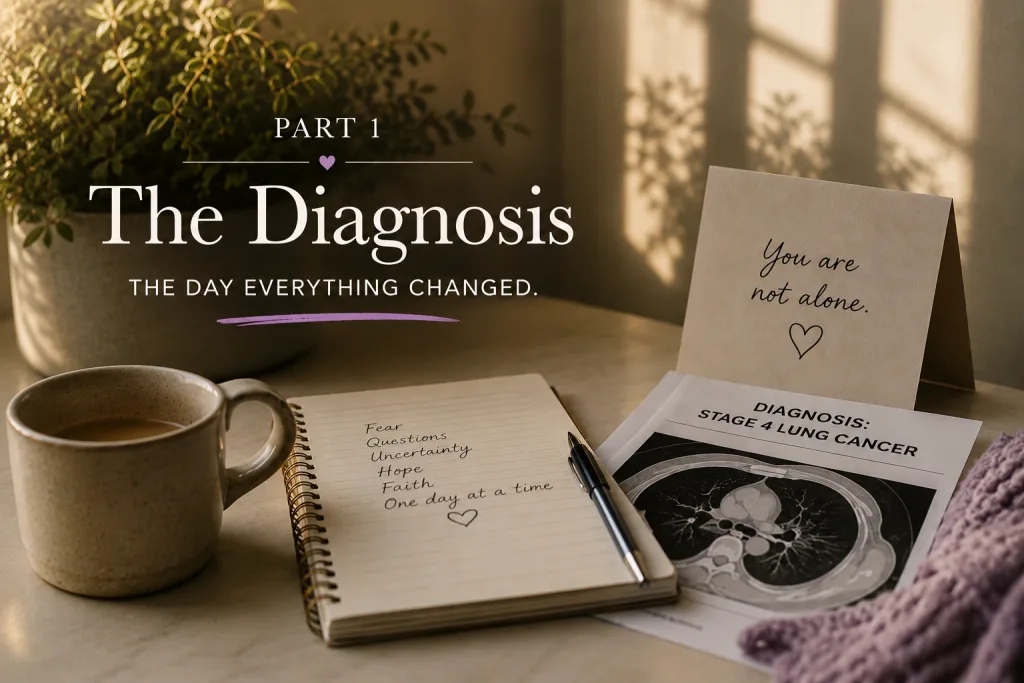
There are dates in life that become permanent markers—dates that divide life into “before” and “after.”
August 2, 2025, became one of those dates for me.
Before that day, I was living life the way most of us do. There were projects to finish, family gatherings to attend, plans to make, and a future that felt exciting. A new beginning, kind of. Not guaranteed, because none of us are promised tomorrow, but exciting. Life was moving forward in the amazing, comfortable way that we often take for granted.
Then came the diagnosis.
What started as a simple doctor’s appointment to investigate some pressure in my chest—not even pain yet, just an uncomfortable pressure that didn’t seem quite right—quickly became something much bigger.
The scan was completed, and we got back in the car to head home. We hadn’t even been on the road for five minutes when I received an email notification that new results had been posted to my patient portal.
Like most people, I expected medical terminology I wouldn’t understand, or something simple like inflammation.
Instead, I opened the portal and saw three words that would change my life forever:
Stage 4 lung cancer.
Even now, those words are difficult to write.
People often ask what it feels like when you hear news like that. The truth is that there aren’t enough words to fully describe it. There is fear, certainly—fear unlike anything I had ever experienced. A fog that surrounds you that you can’t shake. But there is also shock, disbelief, and a strange sense of numbness. You hear the words, but your mind struggles to process them. It feels as though time stops while the rest of the world continues moving around you.
Almost immediately, my mind began searching for answers. How bad is it? How long do I have? What happens next? Will treatment work? Am I going to die?
The questions came faster than the answers ever could.
But before I could even begin to process those fears, another set of questions surfaced—questions that somehow felt even harder.
What about my husband?
How do I tell my children?
What do I say to my grandchildren?
How do I look the people I love most in the eye and tell them something that I can barely comprehend myself?
Those conversations were some of the most difficult moments of my life because suddenly the diagnosis wasn’t just about me anymore. It affected everyone who loves me, everyone who depends on me, and everyone whose future is connected to mine. And how do I let anyone in when my mind is in this state of disbelief.
What many people don’t realize is that a cancer diagnosis is not a single event. It is the beginning of a whirlwind. The days and weeks that follow become a blur of appointments, scans, biopsies, blood work, specialists, procedures, and more information than seems humanly possible to absorb. Everyone is talking, explaining, recommending, and planning, but all you really want is certainty—and certainty is the one thing no one can give you.
Suddenly your life becomes measured by scan dates, lab results, treatment schedules, and doctor’s appointments. Every ache, every pain, and every new symptom becomes a question mark. The physical pain was real, but often the emotional weight was even heavier.
There is something profoundly humbling about sitting across from a physician and realizing that your future now depends largely on people you met only moments ago. You place your trust in surgeons, oncologists, radiologists, nurses, and technicians. You trust their education, their experience, their judgment, and their honesty. You trust them because, you have no other choice.
At some point, every cancer patient comes face to face with something most people spend their entire lives avoiding: mortality.
Not in an abstract sense. Not someday in the distant future. Not eventually.
Now.
Suddenly it is standing directly in front of you.
It feels like running headfirst into a brick wall. The plans stop. The assumptions disappear. The illusion of control vanishes. And standing on the other side of that wall is the unknown.
For me, the unknown was perhaps the hardest part of all. Not knowing what treatment would bring. Not knowing how my body would respond. Not knowing what the next scan would show. Not knowing whether life would ever return to normal or become something entirely different.
It was during those moments, when fear was at its loudest, that my faith became more important than ever. Not because faith removed the fear—it didn’t. And not because faith answered all of my questions—it didn’t do that either. What faith did provide was the reminder that I did not have to walk through the unknown alone.
There were days when I had no answers, no certainty, and no control. Those were the days I learned what trust truly means. Trusting that God already knew the path ahead even when I could not see it. Trusting that He was present in the fear, in the tears, in the waiting rooms, and in the long nights when my mind refused to rest.
I learned that faith is not believing that nothing bad will happen. Faith is believing that no matter what happens, God will walk beside you through it.
And somehow, even in the middle of all that uncertainty, life keeps moving forward. The sun still rises. Family still calls. Friends still show up. There are still birthdays, holidays, laughter, and moments of joy that find their way into the middle of the storm.
What I have learned since that day is that courage is not the absence of fear. Courage is showing up anyway. It is walking into appointments when you are scared of the answers. It is going through procedures, accepting treatment, asking difficult questions, and choosing hope when fear would be easier.
August 2, 2025, was the beginning of a journey I never asked to take.
A journey into the unknown.
This is the story of that journey. I will add new blogs as I can to get up to the now….we are only months away from a year since diagnosis.